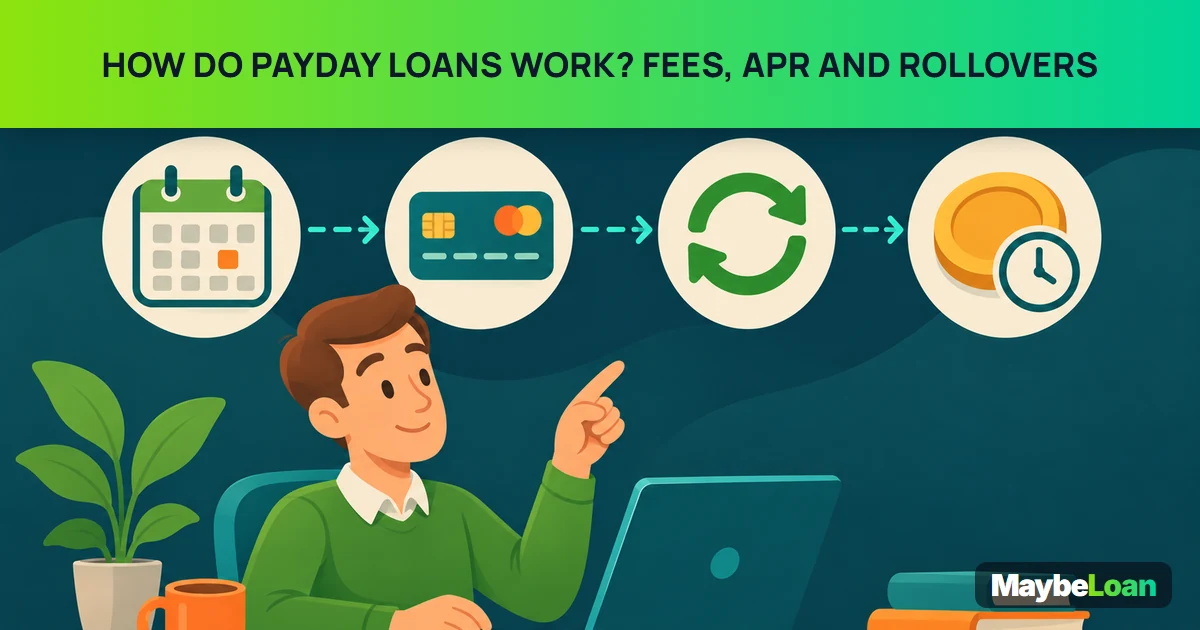
A payday loan works like this: you borrow a small amount and give the lender the right to collect the full amount plus a fee from your bank account, or through a post-dated check, on your next payday. The fee looks modest, but because the term is so short, it works out to a three-digit APR. In South Carolina, for example, a $300 payday loan carries a $45 fee (15% of the principal under SC Code 34-39-180(E)), so you repay $345. If the loan is due in 14 days, that fee works out to an APR of about 391% (South Carolina Department of Consumer Affairs; state figures as of September 2026).
MaybeLoan is a comparison service, not a lender. Payday loans are not available in states where state law prohibits them. Terms, fees and APR are set by the lender within the limits of state law.
APR = fee ÷ amount borrowed × 365 ÷ loan term in days × 100. Example: $45 ÷ $300 × 365 ÷ 14 × 100 = 391.07%, rounded to about 391%. State limits, fees and terms come from each state’s law as recorded in our state regulations data, with a link to the state regulator next to each figure. State figures are as of September 2026 (Louisiana loan limits: October 2026). Lenders set their own terms within state law, so the fee and APR in your loan agreement are the numbers that apply to you.
How a payday loan works, step by step
The federal consumer finance regulator describes the product in one sentence:
A payday loan is usually “a short-term, high-cost loan, generally for $500 or less, that is typically due on your next payday.” – Consumer Financial Protection Bureau
Everything else follows from those three features: a small amount, a high price and one repayment tied to your pay date.
Steps 1 and 2: the amount and how you secure repayment
You agree on an amount within your state’s limit, and the lender gets a way to collect the money back without waiting for you to send it. According to the CFPB, this is done in one of two ways:
- A post-dated check written for the full balance, meaning the amount you borrowed plus the fee.
- An authorization for electronic withdrawal from your bank account, credit union account or prepaid card account.
The lender then pays out the loan: in cash or by check, by depositing the money into your account, or by loading it onto a prepaid card (CFPB).
This is the part people tend to skim, and it matters most later. Whoever holds your check or your authorization can take the money on the due date whether or not the rest of your bills are covered yet.
Step 3: the due date
The due date is usually set around your next payday. On that day, the lender deposits your check or debits your account for the full amount. There are no monthly installments in a standard payday loan: the principal and the fee leave your account in one payment. Each state sets its own term limits; the table in the cost section below shows them for South Carolina, Alabama and Washington.
What matters just as much as the due date is how the loan behaves after you sign.
Payday loan, “payday advance” and cash advance apps are not the same thing
“Payday advance” and “paycheck loan” are other names for the same product: a short-term loan from a lender, repaid in one payment from your next paycheck, with the fee and APR disclosed in a loan agreement. Cash advance apps that let you access part of wages you have already earned are a different arrangement with their own terms and pricing models. If you are using one of them, read its terms separately; the fee and APR math in this article describes payday loans from lenders.
What a payday loan costs: fee per $100 and APR
Fee and APR are not the same number
A payday loan has two cost figures, and lenders have to show both. Under the federal Truth in Lending Act and Regulation Z, the lender discloses the finance charge – “the dollar amount the credit will cost you” – and the annual percentage rate – “the cost of your credit as a yearly rate” (CFPB, Regulation Z § 1026.18).
The fee is what you pay in dollars. The APR shows what that fee would be if the same price were charged over a full year. Because a payday loan lasts only a couple of weeks, a fee that looks small in dollars turns into a three-digit APR.
According to the CFPB, many state laws set a maximum payday loan fee ranging from $10 to $30 for every $100 borrowed, and a typical two-week payday loan with a $15 per $100 fee equates to an APR of almost 400% (CFPB).
Worked example: $300 in South Carolina
South Carolina allows payday loans of up to $550, with a fee of 15% of the principal and a term of up to 31 days (South Carolina Department of Consumer Affairs; SC Code 34-39-180). Here is a $300 loan due in 14 days:
- Fee: $300 × 15% = $45.
- Amount due: $300 + $45 = $345, taken in one payment on the due date.
- Fee as a share of the loan: $45 ÷ $300 = 15% for 14 days.
- APR: 15% × 365 ÷ 14 = 391.07%, or about 391%.
Figures as of September 2026.
Same fee, longer term: why the APR changes
In South Carolina, the fee is 15% of the principal no matter how long the loan lasts, up to the 31-day limit. So a $300 loan still costs $45 whether it is due in 14 days or in 31 days. What changes is the APR:
| Loan (South Carolina) | Term | Fee | You repay | APR |
|---|---|---|---|---|
| $300 | 14 days | $45 | $345 | about 391% |
| $300 | 31 days | $45 | $345 | about 177% |
The dollar cost stays the same; the APR falls only because the same fee is spread over more days. That is also why a payday loan used to bridge a short gap – a seasonal expense, a bill due before payday – is expensive even when the fee in dollars looks manageable: the shorter the term, the higher the yearly rate.
Three states, three formulas
Each state that allows payday loans sets its own fee rule and loan limit. Three examples, using a $300 loan for comparison, plus Louisiana’s loan limit for reference:
| State | Fee rule | Maximum loan | Fee on $300 | Fee on a larger loan | Term | Regulator |
|---|---|---|---|---|---|---|
| South Carolina | 15% of principal | $550 | $45 (repay $345) | $82.50 on $550, the maximum (repay $632.50) | Up to 31 days | SC Department of Consumer Affairs |
| Alabama | $17.50 per $100 | $500 combined across all lenders (statewide database) | $52.50 (repay $352.50) | $87.50 on $500, the maximum (repay $587.50) | 10-31 days | Alabama State Banking Department |
| Washington | 15% on the first $500, 10% on the part above $500 | Set by state law; check with the regulator | $45 (repay $345) | $95 on a $700 loan ($75 + $20; repay $795) | Up to 45 days | Washington Department of Financial Institutions |
For reference, Louisiana caps the loan amount at $740 for deferred presentment transactions and $370 for small loans for September 1, 2026 – August 31, 2027; the state adjusts these limits every year (Louisiana Office of Financial Institutions).
How the APR works out on a 14-day loan: in Alabama, $17.50 per $100 × 365 ÷ 14 = 456.25%, which is why about 456% is the typical APR there. In Washington, the 15% fee on loans up to $500 gives the same result as in South Carolina: about 391% for 14 days. In both states, the term you actually get changes the APR.
State figures as of September 2026; Louisiana loan limits as of October 2026.
A “typical APR” for a state is what a common loan in that state works out to, not a legal cap. Alabama and Washington limit the fee, not the APR, so the APR on your loan depends on the fee and the term in your agreement.
Rollovers and renewals: why paying only the fee does not shrink the debt
What a rollover is
A rollover, also called a renewal or extension, happens when you can’t repay the full amount on the due date. Instead of paying the principal and the fee, you pay only the fee. The lender moves the due date forward, and a new fee is charged for the new period. You have paid money, but you owe exactly the same principal as on the day you borrowed.
That is the mechanism behind the expression “debt cycle”: each rollover buys time, and the time has a price that does not reduce the loan.
What one rollover adds
When a rollover is allowed, you typically pay the fee for the current period, and the full principal moves to a new due date with a new fee. The principal does not get smaller, so each extra period adds another fee on top of what you have already paid:
Total cost = fee for one period × number of periods, and the full principal is still due at the end.
Whether a rollover is allowed, and what it costs, depends on your state’s law and on your loan agreement – check both before you agree to extend.
How states limit rollovers
Because a rollover adds a fee without reducing the principal, several states either ban it or cap how long a loan can be extended and how many loans a borrower can have outstanding. Here is how five states handle it; you can read more on the Wyoming payday loan rules page and the other state pages linked further down.
| State | Rollover rule | Other limits | Regulator |
|---|---|---|---|
| South Carolina | Not allowed (SC Code 34-39-180) | One loan at a time | SC Department of Consumer Affairs |
| Wyoming | Not allowed (W.S. 40-14-364) | – | Wyoming Division of Banking |
| Alabama | 1 rollover maximum, then the loan must be repaid in full | $500 combined outstanding across all lenders | Alabama State Banking Department |
| Nevada | Allowed within 90 days of the original loan date in total (NRS 604A.501) | Original term up to 35 days | Nevada Financial Institutions Division |
| North Dakota | One renewal (at least 15 days) | 60 days in total, including the renewal | North Dakota Department of Financial Institutions |
State figures as of September 2026.
Some states ban rollovers, some allow one or a limited number, and others set no specific limit. The table above covers five states only. Before you agree to extend a loan, check your state regulator’s rules and your loan agreement: an extension that your state does not allow, or one you did not expect to pay for, is a reason to stop and ask questions.
Repayment day: automatic withdrawals and how to stop them
What happens on the due date
On the due date, the lender deposits your post-dated check or debits your account under the authorization you signed. For the payment to go through, the full amount, principal plus fee, has to be in the account that day. If it isn’t, the payment fails and the loan is still owed in full. Planning for repayment day means checking that this one large debit does not land before rent, utilities or other fixed bills that come out of the same account.
Revoking the payment authorization
You have the right to stop a lender from electronically taking money from your account. According to the CFPB, you can revoke the authorization with the lender, with your bank or credit union, or with both. You can also give your bank a stop payment order. To stop a scheduled withdrawal, the stop payment order should reach your bank at least 3 business days before the payment is due.
Revoking an authorization or placing a stop payment order stops the automatic debit, not the debt. You still owe the principal and the fee under your loan agreement. Contact the lender to arrange another way to repay so the loan does not move to collections.
Repayment options if the loan allows them
A standard payday loan is repaid in one payment. Some states also provide for an installment repayment option. Alabama is one of them: state rules for payday loans there include an installment option (Alabama State Banking Department; as of September 2026). The terms of that option – how many payments and over what period – are set out in your loan agreement, so ask the lender before the due date rather than after a payment fails.
If your state is not listed here, check with your state regulator whether your loan can be repaid in installments.
What happens if you can’t repay a payday loan
Missing a payday loan payment sets off a sequence of steps. Knowing the order helps you act early, while you still have the most options.
From a missed payment to collections
- Rollover offer, where your state allows it. The lender may offer to extend the loan for a new fee. As shown above, this keeps the full principal in place.
- Failed check or debit. If the money is not in your account on the due date, the payment fails. The lender may try to collect again under the authorization you gave, unless you have revoked it.
- Collections. An unpaid loan can be handled by the lender’s own collection staff or passed to a debt collection company.
- Court. A lender or collector can file a lawsuit to collect the debt. If a court enters a judgment against you, that judgment can appear on your credit report (CFPB).
If you can see that the due date won’t work, calling the lender before it arrives is usually cheaper than dealing with a failed payment afterward.
Your rights when a debt collector calls
Federal rules limit how debt collectors can contact you. Under Regulation F, which implements the Fair Debt Collection Practices Act:
- Time of day. Calls before 8 a.m. or after 9 p.m. your local time are considered inconvenient (CFPB).
- How often. A collector is presumed to violate the rule if it calls you more than 7 times within 7 days about a particular debt, or calls within 7 days after having a phone conversation with you about that debt (12 CFR 1006.14).
- At work. A collector may not contact you at your workplace if it knows or has reason to know that your employer prohibits such communications (12 CFR 1006.6(b)(3)).
- Other people. A collector generally may not discuss your debt with anyone other than you, your attorney, the creditor, their attorneys and, where the law allows, credit bureaus (12 CFR 1006.6(d)).
One limitation to know: the federal Fair Debt Collection Practices Act and Regulation F generally do not cover the original lender collecting its own debt. Many states have their own debt collection laws that may apply in that case (CFPB).
Can you go to jail over a payday loan?
Not for non-payment in the states we use as examples. State law in South Carolina (South Carolina Department of Consumer Affairs), Alabama (Alabama State Banking Department) and Washington (Washington Department of Financial Institutions) prohibits criminal action against a borrower for non-payment of a payday loan. In Alabama, the rule has an exception only in narrow cases, such as a check written on an account that was closed before the loan was made. That rule does not erase the debt: the lender or a collector can still pursue it through collections or a civil lawsuit. If you live in another state, check the rule with your state regulator.
Where to complain
If a lender or collector breaks the rules, you can file a complaint with your state regulator or state attorney general. You can also submit a complaint to the CFPB online or by phone at (855) 411-2372 (CFPB).
Payday loans and your credit report
According to the CFPB, payday loans are generally not reported to the three nationwide credit bureaus, so repaying one on time usually does nothing to build your credit. That does not mean a payday loan never shows up anywhere:
- Some lenders report to specialty consumer reporting companies rather than the three national bureaus.
- If an unpaid loan is sold or passed to a debt collector, the collector may report it to a national credit bureau.
- A court judgment related to the debt can also appear on your credit report.
In practice, a payday loan rarely helps your credit and can hurt it if it goes unpaid.
Where payday loans are not available, and where “payday” means something else
States where payday lending is prohibited
Payday lending is regulated state by state, and the CFPB notes that in some states payday loans are not available, either because state law does not allow them or because lenders do not operate at the rates the state allows (CFPB). Under our state regulations data, state law effectively prohibits payday lending in 20 states and the District of Columbia. If you live in one of them, this product is not available to you; the link next to each state leads to its regulator:
- Arizona – Arizona Department of Insurance and Financial Institutions
- Arkansas – Arkansas State Bank Department
- Colorado – Colorado Attorney General, Consumer Credit Unit
- Connecticut – Connecticut Department of Banking
- District of Columbia – DC Department of Insurance, Securities and Banking
- Georgia – Georgia Department of Banking and Finance
- Hawaii – Hawaii Division of Financial Institutions
- Illinois – Illinois Department of Financial and Professional Regulation
- Maryland – Maryland Office of Financial Regulation
- Massachusetts – Massachusetts Division of Banks
- Montana – Montana Division of Banking and Financial Institutions
- Nebraska – Nebraska Department of Banking and Finance
- New Hampshire – New Hampshire Banking Department
- New Jersey – New Jersey Department of Banking and Insurance
- New Mexico – New Mexico Financial Institutions Division
- New York – New York Department of Financial Services
- North Carolina – North Carolina Commissioner of Banks
- Pennsylvania – Pennsylvania Department of Banking and Securities
- South Dakota – South Dakota Division of Banking
- Vermont – Vermont Department of Financial Regulation
- West Virginia – West Virginia Division of Financial Institutions
Laws change, so if you are unsure, your state regulator’s website has the current rules.
Ohio and Virginia: legal, but not a classic two-week loan
Short-term loans are legal in Ohio and Virginia, but after reforms in both states they work like small installment loans, not like a two-week loan repaid in one payment on payday.
Ohio (Ohio Division of Financial Institutions, license lookup):
- Loans up to $1,000, generally with a term of 91 days to 1 year.
- APR capped at 28%, plus a monthly maintenance fee of $30 or 10% of the loan amount, whichever is less.
- Total cost capped at 60% of the principal: on a $1,000 loan, no more than $600 in fees and interest, or $1,600 repaid in total.
- Rollovers are not allowed.
Virginia (Virginia Bureau of Financial Institutions, SCC):
- Loans up to $2,500, with a term of up to 24 months.
- APR capped at 36%, plus a monthly maintenance fee of 8% of the loan amount or $25, whichever is less (the $25 limit applies to loans above $312.50), and a returned-payment (NSF) fee of up to $25.
- One loan outstanding at a time. The lender can’t refinance, renew or extend the loan.
If you live in either state, an installment loan comparison is closer to what lenders there actually offer. State figures as of September 2026.
How to check your state
Two checks cover most of what you need before you deal with any lender:
- Is payday lending legal where you live, and on what terms? Your state regulator publishes the rules. For the states used in this article, see the South Carolina payday loan rules, Alabama payday loan limits and Washington payday loan limits pages, each with a link to the regulator.
- Is the lender licensed in your state? Look the lender up with your state regulator. NMLS Consumer Access is a free search tool for checking many state licenses, but not every state’s payday lender licenses may be listed there, so the state regulator remains the main source.
Options to look at before you borrow
A payday loan is one way to cover a short cash gap, and the cost section above shows why it is an expensive one. Before you sign, check a few other routes:
- Ask for more time from the company you owe. Landlords, utilities and medical offices sometimes agree to a later date or a payment plan if you ask before the bill is due.
- Your credit union. If you are a member, ask whether it offers small short-term loans to members and on what terms.
- An installment loan. Repayment is split into several scheduled payments instead of one lump sum on payday, which can be easier to plan around.
- A personal loan. For larger or less urgent expenses, personal loans usually come with longer terms; compare the APR and total cost, not just the monthly payment.
Frequently asked questions
It depends on your state. In South Carolina, the fee is 15% of the principal, so a $300 loan costs $45 and you repay $345 in one payment. On a 14-day term, that equals an APR of about 391%. In Alabama, at $17.50 per $100, the same $300 costs $52.50. State figures as of September 2026.
Because a short-term fee is converted into a yearly rate. A 15% fee charged for 14 days is repeated about 26 times in a year: 15% × 365 ÷ 14 is about 391%. The fee in dollars does not change with the term, but the shorter the loan, the higher the APR. The CFPB notes that a two-week loan with a $15 per $100 fee equals an APR of almost 400%.
A rollover, also called a renewal, means you pay only the fee on the due date and the lender moves the full principal to a new due date with a new fee. The debt does not shrink, so each extra period adds another fee. Some states, such as South Carolina and Wyoming, do not allow rollovers, while others limit them; rules differ by state, so check your state regulator.
On the due date, the lender tries to cash your check or debit your account. If the money is not there, the payment fails and the full amount is still owed. Where your state allows it, you may be offered a rollover with a new fee. An unpaid loan can go to a debt collector, who may report it to a national credit bureau, and it can end up in court.
State law in South Carolina, Alabama and Washington prohibits criminal action against a borrower for non-payment of a payday loan. That does not cancel the debt: the lender or a collector can still try to collect it, including through a civil lawsuit. Rules are set state by state, so if you live elsewhere, check with your state regulator.
Tell the lender that you revoke your authorization for electronic withdrawals, and contact your bank or credit union as well. You can also give your bank a stop payment order at least 3 business days before the scheduled payment (CFPB). This stops the automatic debit, not the debt: you still owe the loan and need another way to repay it.
Usually not directly. According to the CFPB, payday loans are generally not reported to the three nationwide credit bureaus, so paying on time won’t build your credit. Some lenders report to specialty reporting companies, and if an unpaid loan goes to a debt collector, the collector may report it to a national bureau. A court judgment can also appear on your credit report.
It depends on where you live. In our state regulations data, payday loans are legal in 30 states and effectively prohibited in 20 states and the District of Columbia. In Ohio and Virginia, the legal product works like a small installment loan rather than a two-week loan. Check your state regulator’s website, and confirm that any lender you consider is licensed in your state.
If you have worked through the numbers and a payday loan still fits your situation, you can compare options available in your state on MaybeLoan. Availability depends on your state, and the fee, APR and due date in the lender’s agreement are what you will actually pay.
MaybeLoan is a comparison service, not a lender. Payday loans are not available in states where state law prohibits them. Terms, fees and APR are set by the lender within state law. State figures as of September 2026 (Louisiana loan limits: October 2026).