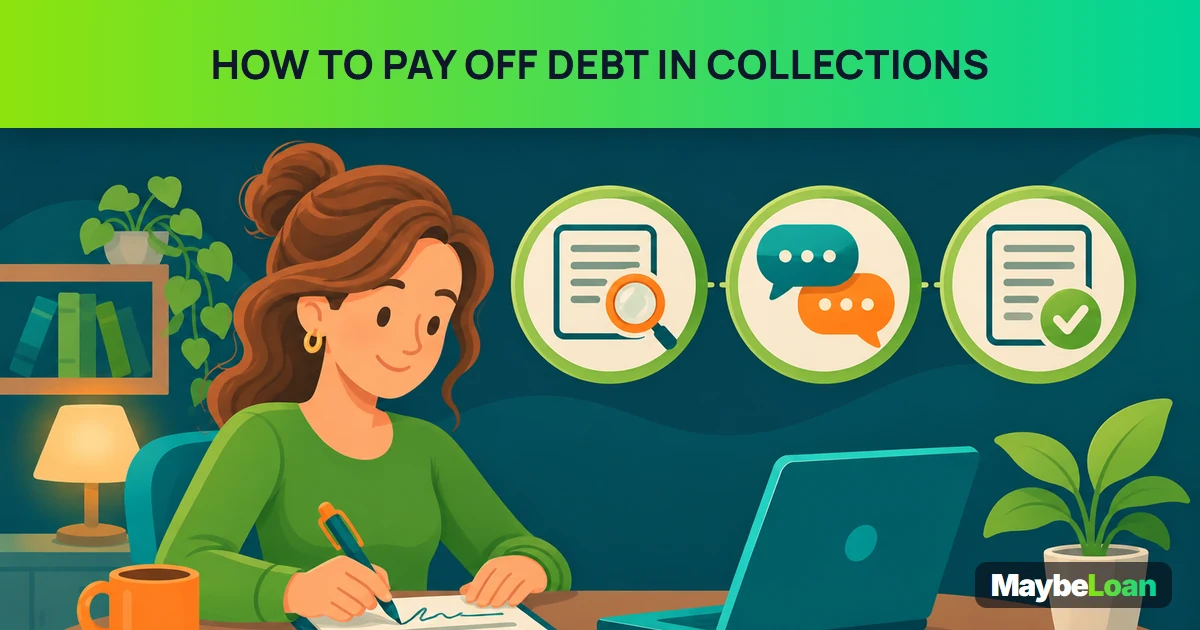
A call or letter from a debt collector is not proof that you owe the money. Pay only after you have checked the debt and have the terms in writing. The safe order: ask for validation information, check the debt against your credit reports and your state’s time limit, choose how to pay, get the deal in writing, pay with a record, then check your report. Paying settles what you owe, but it does not promise the collection will disappear from your credit report.
- Ask the collector for proof of the debt.
- Check that the debt is yours and still collectible.
- Choose full payment, a payment plan or a settlement.
- Get the agreement in writing before you pay.
- After you pay, check your credit report.
Who is contacting you about the debt
Three kinds of companies may contact you: the original creditor you owe, a collection agency working for that creditor, or a debt buyer that bought the debt and collects it for itself.
The federal Fair Debt Collection Practices Act covers personal, family and household debts collected by collection agencies, debt buyers and lawyers. An original creditor that collects its own debt is generally not covered, although your state’s law may protect you more (Ask CFPB). So who is on the other end decides which rules apply.
Whoever is collecting, the debt usually does not go away on its own until it is paid (Ask CFPB). Checking it is a better plan than waiting it out.
Step 1 – Ask for proof before you pay
Do not confirm account details, give bank or card numbers, or agree to a payment until you have seen the debt in writing. Federal rules give you a set way to ask for that proof.
What the validation notice has to tell you
A debt collector must give you validation information in its first contact with you or within 5 days after it. That can be a written notice or, in the first conversation, spoken information (12 CFR 1006.34). The validation period starts when the collector gives you this information and ends 30 days after you receive it. Use the end date printed on the notice rather than counting from the date on the letter. The notice also has ready-made dispute options: “This is not my debt,” “The amount is wrong,” and “Other.” A collector that pushes you to “pay today” is a red flag, because during the validation period it may not pressure you in a way that overrides your right to dispute.
Dispute in writing and keep a copy
If you dispute the debt in writing within the validation period, the collector must stop collecting until it sends you verification of the debt or a copy of a court judgment. A written request for the name and address of the original creditor, sent in the same period, also pauses collection until the collector answers. Not disputing the debt is not an admission that you owe it (12 CFR 1006.38).
Send the letter by certified mail with a return receipt requested, and keep a copy of everything (FTC). The CFPB publishes sample letters for the common cases, such as “I do not owe this debt” and “I need more information.” They are linked from Ask CFPB: What should I do when a debt collector contacts me.
Step 2 – Check that the debt is yours and still collectible
Match it against your credit reports
Compare the collector’s name, the original creditor, the amount and the account details with your credit reports. By law you can get a free report from each of the three credit bureaus once every 12 months. The bureaus also let you request a free report every week at AnnualCreditReport.com, but that weekly access is a permanent bureau program, not a legal right (FTC: Free Credit Reports). If the debt is not on your report, that alone does not mean it is not yours or that it cannot be collected, so check it against Step 1.
Old debt and the time-barred trap
A time-barred debt is one where the statute of limitations has run out. On such a debt a collector may not sue you or threaten to sue (12 CFR 1006.26). It may still contact you by letter or phone, and the debt does not disappear on its own. If a collector sues on a time-barred debt, you can raise the statute of limitations as a defense. The time limit is 3-6 years in most states and sometimes longer, depending on the type of debt, your state and the contract (Ask CFPB). Look up your own state’s limit and the type of your debt before you act.
Be careful with small payments. According to the CFPB, a partial payment or an acknowledgment of the debt may restart the time limit. The FTC says that in some states, a payment or even a written acknowledgment that you owe the debt resets the clock. So do not pay “a little, to make them stop” on an old debt before you have checked how old it is and what your state says.
If you are served with a lawsuit, respond by the deadline in the court papers, either yourself or through a lawyer. Ignoring it can lead to a judgment against you (FTC: Debt Collection FAQs).
Step 3 – Choose how you will pay
Check the amount first
A collector may collect only amounts the contract or the law allows, including interest, fees and charges. Ask for an itemization and compare it with your original agreement before you pay (12 CFR 1006.22).
A payday loan is a common example. A collector may not ask for a postdated check in order to threaten criminal prosecution, and may not deposit it before the date on it. If a postdated check is for more than 5 days out, the collector can deposit it only after giving you written notice 3-10 business days before. The basics of the product are on the payday loans page.
Full payment, payment plan or settlement
The CFPB suggests this order: confirm the debt, work out a realistic plan from your income and expenses (“Don’t pay more than you can afford”), then offer the plan to the collector and explain your situation (Ask CFPB: How do I negotiate a settlement). A payment plan or a settlement is a lawful option, but you can only ask and negotiate: the collector does not have to agree. A credit counselor or a lawyer can help with the talks.
If you owe the same collector more than one debt, the collector must apply your payment to the debt you choose, and may not apply it to a debt you dispute (FTC). State this in writing when you pay.
Forgiven debt may be counted as taxable income (Ask CFPB).
Pay-for-delete: a request, not a right
Pay-for-delete means asking a collector to remove the collection from your credit report in exchange for payment. It is possible only by agreement and is not guaranteed: the collector does not have to agree. The CFPB says that no one has the right to remove negative information, such as late payments, from a credit report if it is accurate (Ask CFPB). Companies that report data must report accurate information and correct what is inaccurate (15 U.S.C. 1681s-2). Even if one collector agrees, the original creditor’s entry or the credit bureaus may keep the record. Do not pay on the strength of a spoken promise to delete.
Paying a collection does not erase the record. Whether and how the account appears on your report after you pay depends on what is reported, not on the payment alone.
Step 4 – Get the deal in writing before you pay
What the letter should say
The CFPB says: “If you agree to a repayment or settlement plan, get the plan and the debt collector’s promises in writing before you make a payment” (Ask CFPB). The FTC adds: before paying a settlement, get a signed letter from the collector saying the amount pays off the whole debt, and keep it with your payment confirmations.
A checklist of what to include:
- the collector’s name, mailing address and phone number;
- the original creditor and the account number;
- the agreed amount and payment schedule;
- a statement that this amount settles the debt in full;
- how the account will be reported after payment, if you agreed on that;
- the date and the collector’s signature.
Keep the letter for good. A collector may not sell or transfer for collection a debt it knows, or should know, has been paid or settled (12 CFR 1006.30). If the debt comes back with another company, the letter is your proof.
Pay in a way that leaves a record
Pay by check or another method that gives you a receipt. Do not share bank or card details until you have confirmed that the collector is real. To pay a collection online, use a portal only after you have checked that it belongs to the collector named in your validation notice and you have the written agreement. A demand for a gift card is a warning sign (see the scam section).
Paying with a record and holding back card details until the collector is verified is practical advice; no law requires it. What protects you is the paper trail: the written agreement and proof of each payment.
Step 5 – After you pay: check your credit report
What stays on the report and for how long
Most negative information can stay on your credit report for seven years (FTC). For collection accounts the seven years run from 180 days after the start of the delinquency that led to the collection. The date the debt went to a collector and the date you pay do not change that, and paying does not reset the period (15 U.S.C. 1681c). A settled account may still show on your report during that time.
Ask for the update, dispute what is wrong
After you pay, ask the collector in writing to update the account to paid or settled, then check your report to see that it was updated. A company that reports data and learns that it is incomplete or inaccurate must promptly tell the credit bureau and send a correction. If you dispute the data with that company, it may not pass it to a bureau without noting that it is disputed (both under 15 U.S.C. 1681s-2).
You can dispute errors on your report yourself, for free. A credit bureau must investigate within 30 days of getting your dispute, and must delete or correct information that is inaccurate, incomplete or cannot be verified (15 U.S.C. 1681i). You can also dispute in writing with the company that reported the information, which as a rule must investigate and respond within 30 days of receiving it (Ask CFPB: How do I dispute an error on my credit report).
Can you get rid of a debt collector without paying?
Ignoring it will not work: the debt does not disappear when you stay silent, and the CFPB advises against ignoring a collector. What you can lawfully do: dispute the debt in writing during the validation period (Step 1), check whether it is time-barred (Step 2), and ask the collector in writing to stop contacting you. The CFPB has a sample letter for that (Ask CFPB).
Ending the calls does not cancel the debt. The FTC notes that an unpaid debt can hurt your credit and that a collector can sue you or seek wage garnishment (FTC). A collector generally needs a court judgment before it can garnish your wages (Ask CFPB), so if court papers arrive, answer by the deadline.
Signs the “collector” is a scam
Red flags before you pay
- You do not recognize the debt.
- The caller refuses to give a mailing address or phone number.
- You are threatened with arrest or the police.
- You get no validation information – not in the first conversation and not in writing within 5 days of it.
- You are pushed to “pay today” before you can check anything.
- The caller insists on a gift card or another payment you cannot trace.
The FTC lists the first three as signs of a fake collector (FTC). Real collectors are also banned from threatening arrest for not paying and from falsely claiming to be a lawyer or a government agency (12 CFR 1006.18). If you see any of these signs, do not pay, and ask for the validation notice in writing.
Where to report
Report a fake or abusive collector to the CFPB at consumerfinance.gov/complaint, to the FTC at ReportFraud.ftc.gov, and to your state attorney general.
What not to do
- Do not pay “a little, to make them stop” on an old debt before you check its age (Step 2).
- Do not give bank or card details to a caller you have not verified.
- Do not rely on a phone promise that is not later confirmed in writing.
- Do not take out a new loan to pay off a collection. It swaps one debt for another and can start a cycle. See how a debt trap forms and how to avoid it.
Frequently asked questions
If the debt is yours and the amount is right, it usually does not go away until it is paid. Check it first. Even if you owe the money, a collector may not harass or lie to you, and you can dispute anything that looks wrong.
Not automatically. A paid or settled collection may stay for seven years, counted from 180 days after the delinquency that led to it. Paying does not reset that period.
Yes, you can ask for a payment plan or a settlement, but the collector does not have to agree. Base your offer on what you can actually afford, and get the plan and any promises in writing before you make the first payment.
It is a request to remove a collection from your report in exchange for payment. It works only if the collector agrees, and no one has the right to remove accurate negative information.
A collector may not sue or threaten to sue on a time-barred debt, but it can still contact you. The limit is 3-6 years in most states, sometimes longer. In some states a partial payment or written acknowledgment may restart the clock.
Share no financial details until you have checked. Ask for the validation notice, a mailing address, a phone number and the original creditor’s name, and compare them with your credit reports. If something does not match, report it to the CFPB, the FTC or your state attorney general.
It can be, once the collector is confirmed through the validation notice and the agreement is in writing. Open the portal from the collector’s verified contact details, never from a link in an unknown text, and save every confirmation.
Treat it as a strong warning sign. The FTC says no real business or government agency will ever tell you to buy a gift card to pay them. Use the same caution with any payment you cannot trace. Do not pay, and ask for the validation notice in writing.
Sources and your next step
Next step: open the CFPB sample letters, pick “I need more information” or “I do not owe this debt,” and send it within the validation period by certified mail.
- CFPB: Debt collectionconsumerfinance.gov
- Ask CFPB: What should I do when a debt collector contacts me (sample letters)consumerfinance.gov
- Ask CFPB: How do I negotiate a settlement with a debt collectorconsumerfinance.gov
- Ask CFPB: Can debt collectors collect a debt that’s several years oldconsumerfinance.gov
- Ask CFPB: Can a debt collector take or garnish my wages or benefitsconsumerfinance.gov
- Ask CFPB: How long does information stay on my credit reportconsumerfinance.gov
- Ask CFPB: How do I dispute an error on my credit reportconsumerfinance.gov
- Regulation F, 12 CFR 1006 (CFPB official copy)consumerfinance.gov
- Fair Debt Collection Practices Act (text at the FTC)ftc.gov
- Fair Credit Reporting Act: 15 U.S.C. 1681c, 15 U.S.C. 1681i, 15 U.S.C. 1681s-2govinfo.gov
- FTC: Debt Collection FAQs and Fake and Abusive Debt Collectors (linked in the sections above), Free Credit Reports, Avoiding and Reporting Gift Card Scamsconsumer.ftc.gov
This article is general information, not legal advice. State laws may give you more protection. MaybeLoan is a loan comparison service, not a lender, debt collector or credit repair company.