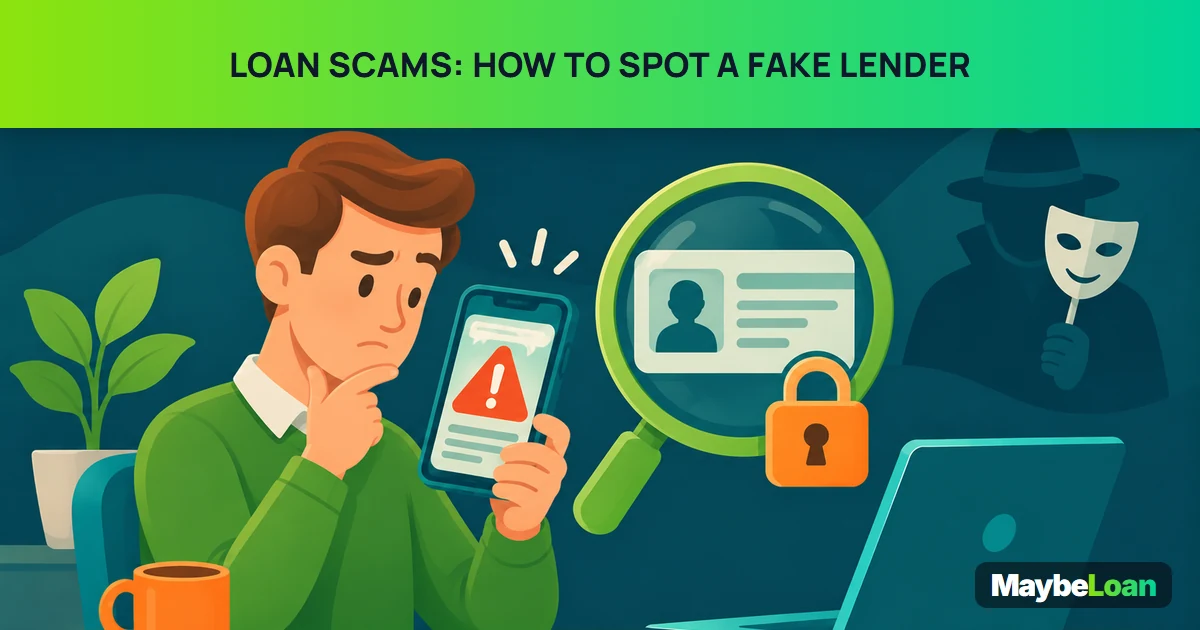
An advance-fee loan scam follows one pattern: a stranger promises you a loan and asks you to pay first, usually with a gift card, a wire transfer, cryptocurrency or a payment app. After you pay, there is no loan and no lender. Looking up the company’s name in a license registry does not settle the question, because scammers can pretend to be real, licensed lenders. Below is how to check an offer, and what to do, payment method by payment method, if you have already paid.
If you have already paid or shared your SSN or bank details, go straight to “What to do if you already paid or shared your details”.
What an advance-fee loan scam looks like
The usual sequence
Someone offers you a loan, a credit card or access to credit, or says they can connect you with a lender that will almost certainly approve you. Then comes the catch: before any money arrives, you have to pay a fee, called processing, insurance, an application fee or something similar.
You pay, and the “lender” goes quiet. No loan arrives, and the company disappears along with your money. The same pattern sits behind many personal loan scams and fake loan company websites: money moves from you to them before any money moves to you.
The wording scammers use
The ads often speak to people who worry about their credit. The FTC lists lines like these as warning signs:
“Bad credit? No problem.” “No hassle – guaranteed.” “We don’t care about your past.”
A legitimate lender does not promise you credit without checking your credit history. It decides after the review, not before. “Guaranteed” in a loan ad is the scammer’s sales line, not a term of a real loan.
Red flags: how to tell a scam from a real offer
The FTC lists four signs of a scam (FTC). In a loan offer, they look like this.
They pretend to be someone you know
Scammers borrow the name of a lender, bank or government agency you already trust, because a familiar name makes the offer feel safe. How to check whether the person really works there is in the licensing section below.
Pressure and a “problem or prize”
The prize is a loan that is “pre-approved” and expires today. The problem is an application that is “stuck” until you pay a fee. Either way, you are told to act now, before you can look anything up or talk it over with someone.
They tell you how to pay
Scammers ask for payment in ways that are hard to undo: gift cards, wire transfers through companies like Western Union or MoneyGram, money transfer services and payment apps, or cryptocurrency. In telemarketing, the Telemarketing Sales Rule also bars sellers from accepting cash-to-cash money transfers and cash reload mechanisms as payment (16 CFR 310.4(a)(10)).
If a loan offer asks you to buy a gift card, send a wire, move crypto or pay through an app before you receive any money, stop. That request is the scam pattern, whatever the fee is called.
A “debt” you don’t recognize
A related trick is a caller who says you owe money on a loan you don’t recognize and must pay today. The FTC explains how to tell fake debt collectors from real ones.
How to check whether a lender is real and licensed
Start with the state
Lenders generally have to be registered or licensed in the states where they operate. To check, contact your state attorney general or the state agency that regulates banks and financial services (FTC). Payday lending is not allowed in every state. Where it is allowed, the lender usually needs a license, and in some states a payday loan made by an unlicensed business may be void, and the lender may not have the right to collect (CFPB). Whether that applies to you depends on your state’s law, so do not assume you can skip repayment. Ask your state regulator or a consumer protection office first.
Your state’s consumer protection office is listed on USA.gov.
Examples of state lookups
Most state regulators have a license search on their site. Here are three examples:
- Ohio: the state’s License Lookup.
- Iowa: the Iowa Division of Banking, which has License Verification for licensed and regulated entities.
- Kansas: the Office of the State Bank Commissioner, which has a Company Lookup.
These are examples, not a full list. Other states have their own regulator and search, so check a lender’s license status with your own state’s regulator.
NMLS Consumer Access, and what it does not prove
NMLS Consumer Access is a free public search of company licenses in areas such as mortgage, consumer finance, debt and money services (NMLS). Some state regulators use NMLS for the licenses they oversee; Iowa’s Division of Banking, for example, uses NMLS for the licenses it regulates (Iowa Division of Banking). Not every state or license type may show up there, so if you do not find a company, that is not proof of a scam by itself. Check with your state regulator before drawing a conclusion.
A real name is not enough
Scammers can say they are a real, licensed company. A license in a registry shows that a company exists. It does not show that the person texting or calling you works for it. Match what you were sent (website address, phone number, email, the offer itself) against what the regulator or the company’s own official site shows. Go to that site yourself instead of using a link or phone number from the message.
Search for complaints, but as an extra step
The FTC also suggests searching the company name with words like “scam,” “complaint” or “review.” It is an additional step, not a replacement for checking the license. The CFPB complaint database is public, has no personal details, and can be searched by company name (CFPB).
Is an upfront fee illegal? What real lenders can charge
The federal rule is narrower than “all upfront fees are illegal”
It depends. The Telemarketing Sales Rule bars a telemarketer from asking for or receiving payment before you get a loan when the telemarketer guaranteed the loan or said you are likely to get it (16 CFR 310.4(a)(4)). For advance-fee loans, the rule covers outgoing calls and also incoming calls you make in response to an ad in general media or direct mail (FTC). The FTC puts it this way:
“It’s illegal for telemarketers to promise you a loan or other credit and ask you to pay for it up front and before they deliver.” (FTC)
The rule is about telemarketing plus a guarantee or a high likelihood of success. It does not say that every fee charged by anyone before funding is illegal.
What a legitimate lender does
A real lender may charge an application or appraisal fee, but it does not guarantee approval in exchange for that payment. The FTC calls any up-front fee that a lender wants to collect before granting the loan a cue to walk away, especially if it is called “insurance,” “processing” or “paperwork.” Under the Truth in Lending rules, a creditor must disclose the cost of credit, including the finance charge and APR, before you sign the contract (12 CFR 1026.17(b)). Fees are disclosed in the loan agreement.
Expensive is not the same as fake
A licensed payday lender operates legally where state law allows it, and the loans are expensive. The problem is unlicensed lenders and fake lenders. Payday loans are banned or effectively blocked by rate caps in 20 states and DC, so the first question is what your state allows. If you are weighing a high-cost loan, read how debt traps work before you decide.
Phishing and stolen data: fake lender sites, texts and calls
Not every loan scam asks for a fee. Some are after your data. Phishing emails and texts try to get your personal and financial information (FTC). Loan scam texts follow a familiar script: urgency, a request to “confirm your details”, a link to make a payment. Legitimate companies don’t ask for your account details by text message (FTC).
Treat loan scam calls the same way: look up the company’s official number yourself and call back. Forward spam texts to 7726 (SPAM), and forward phishing emails to [email protected].
What to do if you already paid or shared your details
Contact whoever moved the money, by payment method
Act quickly, and start with the company that moved the money. Ask them to reverse the payment or refund it. What is possible depends on how you paid, and there is no guarantee you will get the money back (FTC).
| How you paid | Who to contact first | What to do |
|---|---|---|
| Credit or debit card | Your card issuer, at the number on the back of the card | Report the fraudulent charge and ask them to give your money back |
| Bank transfer | Your bank or credit union | Report the fraudulent transfer and ask them to reverse it and refund you |
| Wire transfer | The wire company, such as Western Union or MoneyGram | Tell them a scammer tricked you and ask them to reverse the transfer |
| Gift card | The company that issued the card, at the number on the card | Tell them the card was used in a scam, ask for a refund, and keep the card and the receipt |
| Payment app | The payment app, through its official support | Report the fraudulent payment and ask them to reverse it |
| Cryptocurrency | The exchange or the crypto ATM operator | Ask them to reverse the transaction, and report it to the FTC; crypto does not have the protections cards do |
Based on the FTC’s guidance for people who were scammed. The table shows who to contact first, not what each company is required to do.
If you gave your SSN, password or account details
If a scammer has your Social Security number, report it at IdentityTheft.gov, which gives you a report and a personal recovery plan. If you shared a login or password, change it to a new, strong one and turn on two-factor authentication.
Credit freeze and fraud alert
If a scammer has your Social Security number or other identifying details, two free tools can make it harder to open credit in your name. A credit freeze restricts access to your credit report. Placing and lifting it costs $0, it does not affect your credit score, and it stays in place until you remove it. You place it with each of the three credit bureaus: Equifax, Experian and TransUnion. A fraud alert tells businesses to verify your identity before extending credit. You only need to contact one bureau, and it notifies the other two. An initial fraud alert lasts one year and can be renewed (FTC).
Watch for recovery scams
After you lose money, someone may contact you offering to get it back for a fee. Government agencies and legitimate organizations don’t charge you for help getting money back (FTC). In telemarketing, the Telemarketing Sales Rule bars charging for recovery until 7 business days after the money has been returned to you, with an exception for licensed attorneys (16 CFR 310.4(a)(3)).
Where to report a loan scam
Fraud and scams
Report the scam to the FTC at reportfraud.ftc.gov. You can also file with the FBI’s Internet Crime Complaint Center (IC3), the central point for complaints about cyber-enabled fraud. IC3 reviews complaints and may refer them to law enforcement, but a response to each one is not guaranteed. You can also contact local police or the sheriff and your state attorney general; your state’s consumer protection office is listed on USA.gov. Reporting helps investigators, but none of these agencies promises to get your money back.
When a licensed company broke the rules (CFPB)
A CFPB complaint is sent to the company, which usually responds within 15 days and in some cases takes up to 60. That makes it a channel for real financial companies, for example over a disputed fee or a rule violation. It is not a channel for an anonymous scammer. If you suspect a scam, the CFPB points you to local police or the sheriff, your state attorney general, and the FTC at ReportFraud. You can file at consumerfinance.gov/complaint or call (855) 411-2372.
MaybeLoan is a loan-matching service, not a lender. We don’t make loans, loan offers or credit decisions, and we don’t charge borrowers a fee for using our service (see our disclaimer). So if someone says they’re “from MaybeLoan” and asks you to pay before you get a loan, that isn’t us.
This article is general information, not legal or financial advice. Information current as of October 2026.
Loan scams: frequently asked questions
It depends. It is illegal for a telemarketer to ask you to pay before you get a loan they guaranteed or said you were likely to get. A real lender may charge an application fee, but cannot guarantee approval for it. A lender that guarantees approval for a payment up front is a red flag.
Contact your state attorney general or the state agency that regulates financial services, many of which offer a license search. Ohio, Iowa and Kansas are examples. NMLS Consumer Access is another free tool, but not all state licenses are listed there, so not finding a company is not proof of a scam.
Treat it as suspicious. Phishing texts try to get your personal and financial details, often with urgency or a payment link, and legitimate companies don’t ask for your account details by text. Don’t tap the links or reply with information. Forward the text to 7726 (SPAM), and check the lender through its official website instead.
Maybe, but there is no guarantee. Contact whoever moved the money right away, such as your card issuer, bank, wire company or payment app, and ask them to reverse or refund the payment. Options differ by payment method, and cryptocurrency does not have the protections that cards do.
No. Licensed payday lenders operate legally where state law allows it, although the loans are expensive. The problem is unlicensed lenders and fake lenders that ask for payment first. Payday loans are banned or effectively blocked by rate caps in 20 states and DC, so check what your state allows.
Report it at IdentityTheft.gov, which gives you a personal recovery plan. Consider a free credit freeze with each of the three bureaus, Equifax, Experian and TransUnion, or a fraud alert placed through one bureau; an initial alert lasts one year. If you shared a password, change it and turn on two-factor authentication.
The CFPB sends complaints to the company, so it suits licensed financial companies, not anonymous scammers. Report a suspected scam to the FTC at reportfraud.ftc.gov.
Treat it as a likely recovery scam: government agencies and legitimate organizations don’t charge to help you get money back. Don’t pay, and report the offer to the FTC.
- FTC: What to know about advance-fee loansconsumer.ftc.gov
- FTC: How to avoid a scamconsumer.ftc.gov
- FTC: What to do if you were scammedconsumer.ftc.gov
- FTC: Credit freezes and fraud alertsconsumer.ftc.gov
- FTC: How to recognize and avoid phishing scamsconsumer.ftc.gov
- FTC: How to recognize and report spam text messagesconsumer.ftc.gov
- FTC: Refund and recovery scamsconsumer.ftc.gov
- FTC: Fake and abusive debt collectorsconsumer.ftc.gov
- FTC: Complying with the Telemarketing Sales Ruleftc.gov
- eCFR: 16 CFR 310.4, abusive telemarketing acts or practicesecfr.gov
- CFPB: 12 CFR 1026.17, general disclosure requirementsconsumerfinance.gov
- CFPB: How can I tell if a payday lender is licensed to do business in my state?consumerfinance.gov
- CFPB: Submit a complaintconsumerfinance.gov
- FBI: Internet Crime Complaint Center (IC3)ic3.gov
- IdentityTheft.govidentitytheft.gov
- USA.gov: State consumer protection officesusa.gov
- NMLS: Information about NMLS Consumer Accessmortgage.nationwidelicensingsystem.org
- Ohio: License Lookupelicense2-secure.com.ohio.gov
- Iowa Division of Bankingidob.iowa.gov
- Kansas Office of the State Bank Commissionerosbckansas.gov