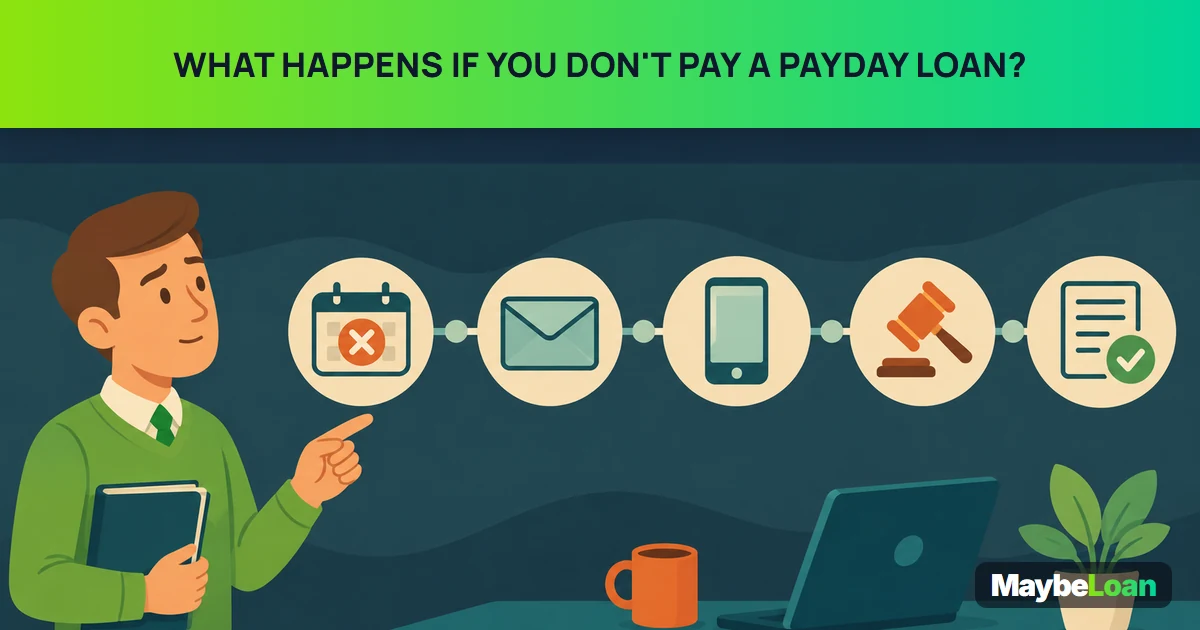
If you don’t pay a payday loan, the debt doesn’t go away. The lender will keep trying to collect, the debt can be passed to a debt collector, and you can be sued. You can’t be arrested for the debt itself, and your wages or bank account can be garnished only after a court judgment. Payday loans are sometimes called cash advances – everything below applies to them too.
- The debt stays. Missing the due date doesn’t cancel it.
- You can’t be arrested for not paying. A warrant is possible only if you’re sued and ignore a court order to appear (CFPB).
- Your wages or bank account can be garnished only with a court order (CFPB).
- Payday loans usually don’t show up on credit reports, but a default that goes to collections or to court can.
This article is general information, not legal advice. State laws vary and may give you more protection.
The steps below are the usual order. How fast they happen, and whether every step happens at all, depends on your lender, your contract and your state.
What happens after you miss a payday loan payment, step by step
Each step says what is set by law and what depends on your lender and state.
Step 1: The payment fails and the lender tries again
Depends on your lender and state: how often the lender retries and what each failed try costs you.
On the due date, the lender tries to collect – usually by cashing the postdated check you gave it or by pulling the money electronically from your bank account. If the account doesn’t have enough in it, the payment fails. The lender may then try again. Your bank may charge its own fees for a returned payment, so repeated failed tries can cost you money even before anything else happens.
A federal CFPB rule in effect since March 30, 2025 generally bars a lender from trying a third time after two failed withdrawals in a row unless you give new authorization (12 CFR 1041.8). The CFPB has said it won’t prioritize enforcing it and plans to reconsider the rule, so your lender may not follow it – your bank-side steps (below) matter more.
Ohio has its own state rule. There, these loans are usually repaid in installments over 91 days to 1 year rather than in one payment. After 2 failed withdrawal attempts in a row, a lender can’t try again without your new written authorization (Ohio Rev. Code 1321.411, state rules as of September 2026, Ohio Division of Financial Institutions). More on payday loans in Ohio.
Step 2: How to stop repeated withdrawals
Set by law: you can take back the lender’s permission to pull money from your account.
When a lender keeps hitting an empty account, every attempt can bring another bank fee. The CFPB describes three steps to stop it (CFPB):
- Tell the lender you are revoking your permission for automatic withdrawals.
- Tell your bank or credit union that you have revoked that authorization.
- Give your bank a stop payment order at least 3 business days before the scheduled withdrawal. The bank may charge a fee for this.
Keep a note of when and how you contacted the lender and the bank.
Revoking or cancelling automatic payments doesn’t cancel your contract with the payday lender. You still owe the balance, so talk to the lender about how you will repay it.
Step 3: Fees and rollovers – what your state allows
Depends on your state: whether the lender can roll the loan over, and how many times.
A rollover (also called a renewal or extension) pushes back the due date instead of the loan being paid off. The balance doesn’t go away – check in your contract what a rollover costs before you agree to one. It moves the problem forward in time; it doesn’t solve it. States set very different limits. Three examples, state rules as of September 2026:
- South Carolina: rollovers aren’t allowed (SC Code 34-39-180, South Carolina Department of Consumer Affairs).
- Alabama: one rollover at most, then the loan must be repaid in full (Alabama State Banking Department). See payday loans in Alabama.
- Nevada: a lender can’t extend, renew or refinance the loan beyond 90 days from the date it was made (NRS 604A.501, Nevada Financial Institutions Division).
On late or collection fees, state rules are thin: for most states our data doesn’t list a specific charge for a missed payday payment. What the lender can charge you is set out in your loan contract. If a fee looks wrong, ask your state regulator whether it’s allowed. Your bank’s fees for a returned payment are separate from anything the lender charges.
Step 4: Ask for an extended payment plan – before the due date if you can
Depends on your lender and state: whether a plan is offered and what it costs.
If you can see that you won’t be able to pay, contact your lender right away – ideally before the due date – and ask for an extended repayment plan or whether there are other options (CFPB). An extended plan lets you repay in smaller installments over a longer period. Whether you can get one, and what it costs, depends on your state’s law and the lender’s own policy. Ask for the terms in writing before you agree.
Some states, such as Alabama and Alaska, include an installment option in their payday rules – ask your lender and check details with your state regulator (Alabama State Banking Department, Alaska Division of Banking and Securities).
Step 5: The debt goes to a collector
Depends on your lender: whether it keeps collecting itself, hires a collection agency or sells the debt, and when.
There is no fixed point at which a payday loan goes to collections. When it does, calls and letters start coming from a company you may not recognize, and that company now handles the debt. Your rights with a collector are covered in a separate section below.
One limit to know: the federal debt collection rules (the Fair Debt Collection Practices Act and Regulation F) generally don’t cover the original lender collecting its own debt. Your state may have its own laws that do (CFPB).
Step 6: What reaches your credit report
Set by law: a debt collector has to contact you before it reports the debt.
Payday loans usually aren’t reported to the three nationwide credit reporting companies. That changes when things go wrong: if you default, the debt is sent to collections, or you’re sued, that negative information can show up on your credit report and hurt your score (CFPB).
A debt collector can’t report the debt to a credit bureau until it has communicated with you about it – by speaking with you, or by sending you a letter or electronic message and then waiting a reasonable time to see whether it comes back as undeliverable (12 CFR 1006.30(a)(1)).
Negative information generally stays on your report for up to seven years. Lawsuits and judgments can stay longer if your state’s statute of limitations is longer.
Step 7: The lender or collector sues
Set by law: garnishment needs a court order.
A lender or a debt collector can file a lawsuit to collect an unpaid payday loan. A court judgment is what opens the door to garnishing your wages or bank account (CFPB).
The bigger risk is ignoring the lawsuit. If you don’t respond, the court can enter a default judgment against you without hearing your side. Some people only find out when money is taken from their paycheck or account.
If you’re served with a summons, read it, find the deadline to respond that it states, and respond by that date. Free legal aid programs can help you understand your options and prepare a response.
A summons has a deadline. Missing it can lead to a default judgment, and a judgment can lead to garnishment. Ignoring a court order to appear can also lead a judge to issue a warrant.
Step 8: A judgment and garnishment – what can be taken
Set by law: garnishment needs a court order, and federal law caps how much can be taken from your wages.
If the lender or collector wins in court, the judgment can let it garnish your wages or your bank account – but only through a court order. Without one, neither the lender nor a collector can garnish your pay.
For an ordinary debt like a payday loan, federal law limits how much your employer can withhold from your wages each week. The most that can be taken is the lesser of:
- 25% of your disposable earnings, or
- the amount by which your weekly disposable earnings exceed 30 times the federal minimum wage (30 x $7.25 = $217.50).
Disposable earnings are what’s left of your pay after legally required deductions, such as taxes (U.S. Department of Labor, Fact Sheet #30). In practice, per week:
- $217.50 or less in disposable earnings – nothing can be garnished;
- more than $217.50 but less than $290 – only the part above $217.50;
- $290 or more – up to 25%.
Illustrative example: your weekly disposable earnings are $250. 25% of that is $62.50. The amount above $217.50 is $250 – $217.50 = $32.50. The lesser of the two is $32.50, so that is the most that can be withheld that week.
If your state’s law allows less to be garnished, the state limit applies instead. Federal law also bars your employer from firing you because your wages are garnished for any one debt.
If Social Security, VA, federal retirement (OPM) or Railroad Retirement benefits are paid into your account by direct deposit and the bank receives a garnishment order, the bank must look back two months and protect an amount equal to the benefits deposited in that period (or your whole balance, if it’s lower). You keep full access to that amount: the bank can’t freeze it or take a garnishment fee from it (31 CFR Part 212). Money above that amount isn’t protected automatically – you may need to ask the court for an exemption. This automatic protection doesn’t apply to orders from the United States or a state child support agency.
Can you go to jail for not paying a payday loan?
No. Not paying a payday loan is not a crime you can be arrested for. The CFPB puts it this way:
No, you cannot be arrested for defaulting on a payday loan. However, if you are sued or a court judgment has been entered against you and you ignore a court order to appear, a judge may issue a warrant for your arrest. (CFPB)
So the real risk of arrest comes from ignoring the court, not from the unpaid loan.
A debt collector who threatens you with arrest or jail is breaking federal rules: collectors can’t threaten action that can’t legally be taken or that they don’t intend to take (12 CFR 1006.18). They also can’t demand a postdated check in order to threaten you with criminal prosecution. If you get threats like these, report them to your state attorney general or the CFPB.
Your rights when a collector calls about a payday loan
Once a payday loan is with a debt collector, federal rules limit how the collector can contact you (12 CFR 1006.6):
- Time of day: a collector generally can’t call before 8 a.m. or after 9 p.m. your local time.
- Your job: a collector can’t contact you at work if it knows or has reason to know your employer doesn’t allow it.
- Other people: a collector can’t discuss your debt with family or anyone else except you, your spouse, your attorney, the creditor, their attorneys or a credit reporting company. A collector may contact other people only to find your contact information, without mentioning the debt.
Call frequency has a test too. A collector is presumed to break the law if it calls you more than 7 times within 7 days about one debt, or calls within 7 days after a phone conversation with you about it (12 CFR 1006.14). This is a presumption, not a hard limit on calls.
Remember that these federal rules generally don’t apply when the original lender collects the debt itself. Your state’s laws may still protect you.
How your state’s rules change this
Rollover limits, payment plan options, collection attempts and garnishment rules all differ from state to state. Check your state regulator’s site, and see how payday loans are regulated state by state. Payday loans aren’t offered under state law in some states; if you live in one, check with your state regulator about the loan you have.
In Ohio, these loans are usually repaid in installments over months rather than in one payment, so the step-by-step timeline above doesn’t apply word for word.
What to do right now
If you can’t pay a payday loan, these steps protect you most:
- Contact your lender before the due date and ask for an extended repayment plan (CFPB). Get any new terms in writing.
- If withdrawals keep failing, revoke the lender’s authorization and give your bank a stop payment order (see Step 2).
- Check that the lender is licensed in your state with your state regulator. NMLS Consumer Access can help you search.
- Don’t take out a new payday loan to pay off the old one. Read when to look for alternatives to a payday loan.
- Open every letter from a court and respond by the deadline.
- Get free help: a nonprofit credit counselor, a legal aid office or, if you’re in the military, your installation’s JAG office.
- Report threats or unfair practices to the CFPB at consumerfinance.gov/complaint or (855) 411-2372, or to your state attorney general.
Frequently asked questions
No. You can’t be arrested for defaulting on a payday loan (CFPB). A warrant is possible only if you’re sued and ignore a court order to appear.
Only with a court order. The lender or collector has to sue you and win a judgment first (CFPB). Federal law then caps wage garnishment at the lesser of 25% of your weekly disposable earnings or the amount above $217.50, and your state may allow less.
It can. Payday loans usually aren’t reported to the three nationwide credit reporting companies, but if you default and the debt goes to collections or to court, that can appear on your credit report and lower your score (CFPB). Negative information generally stays up to seven years.
Tell the lender you’re revoking permission for automatic withdrawals, tell your bank or credit union you’ve revoked it, and give the bank a stop payment order at least 3 business days before the scheduled withdrawal (CFPB). Your bank may charge a fee. You still owe the balance.
A debt collector can’t contact you at work if it knows or has reason to know your employer doesn’t allow it. It can’t discuss your debt with family or anyone else except you, your spouse, your attorney, the creditor, their attorneys or a credit reporting company. A collector may contact other people only to find your contact information, without mentioning the debt (12 CFR 1006.6). These federal rules generally don’t cover the original lender; state laws may.
The deadline to sue is 3 to 6 years in most states, sometimes longer, depending on your state, the type of debt and your contract (CFPB). A partial payment may restart it. After the deadline, a debt collector can’t sue or threaten to sue (12 CFR 1006.26). If you’re sued after that, the expired deadline may be a defense. The debt itself doesn’t disappear.
Don’t ignore it. Respond by the deadline it states – otherwise the court can enter a default judgment, which can lead to garnishment (see Step 7).
Once this loan is paid off, it helps to plan so a short-term gap doesn’t turn into the same situation again. See how to avoid a debt trap.
MaybeLoan is a loan comparison service, not a lender or a debt collector. This article is general information, not legal advice. State rules as of September 2026 for Alabama, Alaska, Nevada, Ohio and South Carolina.
- CFPB: How can I stop a payday lender from electronically taking money out of my account?consumerfinance.gov
- CFPB: What can I do if I can’t repay my payday loan?consumerfinance.gov
- CFPB: Can a payday lender garnish my bank account or my wages?consumerfinance.gov
- CFPB: Could I be arrested if I don’t pay back my payday loan?consumerfinance.gov
- CFPB: Can taking out a payday loan help rebuild my credit?consumerfinance.gov
- CFPB: How long does information stay on my credit report?consumerfinance.gov
- CFPB: Can debt collectors collect a debt that’s several years old?consumerfinance.gov
- CFPB: What laws limit what debt collectors can say or do?consumerfinance.gov
- 12 CFR 1041.8 (payment withdrawal rule) and CFPB, March 28, 2025 statement on enforcement prioritiesconsumerfinance.gov
- Regulation F: 12 CFR 1006.6, 1006.14, 1006.18, 1006.22, 1006.26, 1006.30consumerfinance.gov
- FTC: Fair Debt Collection Practices Act (text)ftc.gov
- U.S. Department of Labor: Fact Sheet #30, Federal Wage Garnishment Lawdol.gov
- 31 CFR Part 212 and U.S. Treasury, Guidelines for garnishment of accounts containing federal benefit paymentsgovinfo.gov
- State regulators: Alabama State Banking Department; Alaska Division of Banking and Securities; Nevada Financial Institutions Division (NRS 604A.501); Ohio Division of Financial Institutions (Ohio Rev. Code 1321.411); South Carolina Department of Consumer Affairs (SC Code 34-39-180)banking.alabama.gov